

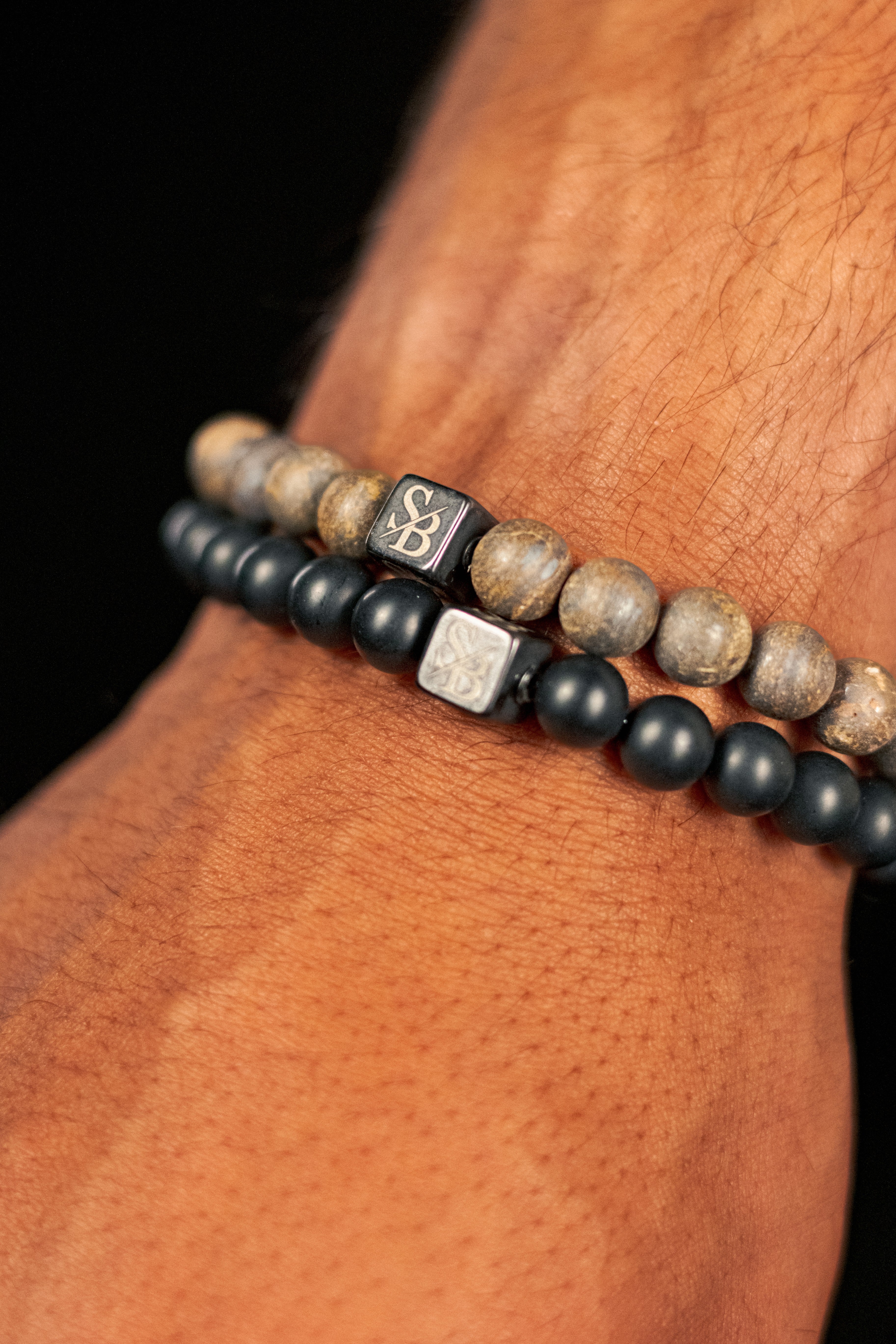
You go looking for the name of a black stone and the same two results come up everywhere. The list is longer than that. For bracelets the ones that count are obsidian, hematite, larvikite, lava stone, black agate and snowflake obsidian. Onyx belongs in that conversation too, and we deliberately do not stock it. Why, further down. In a display case these stones all look the same. In your hand they do not: one is volcanic glass, one is polished iron oxide, one is quartz that took millions of years to form. If you want the full range first, it is in our gemstone bracelet collection.

Black gemstones: the names worth knowing
There are dozens of dark minerals. For a bracelet these are the seven names you keep running into. Each one is a different material, with a different hardness and a different effect on the wrist.
| Name | What it actually is | Look |
|---|---|---|
| Obsidian | Volcanic glass | Deep black, high shine |
| Matte obsidian | The same glass, matte finished | Velvet black, no reflection |
| Hematite | Iron oxide | Silver grey, metallic |
| Larvikite | Norwegian igneous rock | Dark grey with blue flashes |
| Lava stone | Solidified lava | Matte black, porous |
| Black agate | Chalcedony, so quartz | Evenly black, soft shine |
| Snowflake obsidian | Obsidian with cristobalite inclusions | Black with grey white markings |
Are any of these real gemstones?
A fair question, and the honest answer is: only partly. Mineralogically obsidian is not a gemstone, it is glass. Lava stone and larvikite are rocks, not minerals. Hematite is an ore mineral. Strictly speaking, agate is the only genuine semi-precious stone in this group, because it belongs to the quartz family.
For what you wear on your wrist, none of that changes anything. What counts is hardness, weight, colour depth and how the stone handles light. We write "black gemstones" because that is what people search for, and then we tell you what you are actually holding. If you want the difference between the material groups spelled out, it is in our overview of types of natural stone bracelets.
Why we do not stock onyx
Onyx appears in every list of black stones, and for good reason: evenly black, hard enough for anything, endlessly wearable. The catch is in the trade. A large share of the black onyx beads on the market is dyed agate, and that dyeing cannot be spotted reliably from the outside. We work only with undyed natural stone, so onyx is not in our range. If the even, quiet black is what you are after, black agate and matte obsidian both do the same job. The full comparison is in our guide to onyx stone.
Glossy or matte: the difference you see immediately
If you are looking for a dark stone with shine, you end up at polished obsidian almost every time. The surface reads like lacquered wood and catches every light source in the room. It is the most noticeable black stone there is.
The opposite is matte black. Matte obsidian is the same material but absorbs light instead of mirroring it. The result is a velvet black that sits quieter and still holds your eye. Lava stone goes one step further: the porous surface has no shine at all and feels rough to the touch.
In between sits hematite with its metallic sheen. That is not a glass shine but a soft silver tone, closer to polished metal than to a stone.
Volcanic glass, deep black, with the strongest shine in the field. Lighter than hematite, but visually more powerful than any other dark stone. Available polished and matte.
View obsidianTechnically dark silver grey rather than black. In a dark stack hematite takes the metallic accent. Iron oxide with a density you notice the moment you pick it up.
View hematiteNorwegian rock with blue flashes of light in a dark ground. Not a gemstone in the narrow sense, but that schiller makes it special. For anyone who wants something nobody places straight away.
View larvikiteThe same volcanic glass, only with a matte finished surface. Absorbs light instead of reflecting it. The result is a velvet black stone that does not shine and still holds attention.
View obsidianThe only genuine semi-precious stone on this list. Quartz family, so hard and scratch resistant, with a quiet, even black. The honest alternative to dyed onyx.
View agateHematite vs obsidian, and where onyx fits
These three get compared more than any others, so here it is in one place. Obsidian is volcanic glass: deep black, high shine, 5 to 5.5 on the Mohs scale, medium weight. Hematite is iron oxide: silver grey with a metallic sheen, 5.5 to 6.5, and clearly the heaviest of the three on the wrist. Onyx, or rather the black agate sold under that name, is chalcedony: evenly black with a softer shine, 6.5 to 7, and the hardest of the three.
Put simply: pick obsidian if you want the darkest, glossiest look, hematite if you want to feel the weight and a metallic accent, and black agate if you want the one that survives daily wear with the fewest marks.
| Property | Obsidian | Black agate | Hematite | Larvikite |
|---|---|---|---|---|
| Colour | Deep black, high shine | Evenly black, soft shine | Silver grey, metallic | Dark grey, blue flashes |
| Weight | Medium | Medium | Very heavy | Medium to heavy |
| Hardness (Mohs) | 5 to 5.5 | 6.5 to 7 | 5.5 to 6.5 | 6 to 6.5 |
| Care | Careful with scratches | Very low maintenance | Keep it dry | Low maintenance |
| Best for | Maximum impact | Every day, office | Wanting to feel weight | A character of its own |

Which dark stone suits you
The decision comes down to three things: how it should feel, how much it may stand out, and what you wear it for.
You want the stone that gets noticed most? Polished obsidian. The deep shine catches every light and makes people look twice. You want something you wear every day without thinking about it? Black agate. The hardness makes it robust and the even black fits any situation. You want to feel the weight? Hematite. No other stone sits as solidly on the wrist.
And if you want something nobody else is wearing: larvikite. The blue flashes in the dark ground start conversations that no one expects from a black bracelet.
Start with obsidian if you do not own a dark stone yet. It is the most versatile entry. Hematite joins as the second bracelet, for weight and contrast. Black agate as the third, for the days it should stay quiet. A dark stack needs no more than that.
Combining dark stones with colour
A black bracelet is a canvas. Put a second stone next to it and the effect gets stronger, not busier. These are the combinations that work best.
| Combination | Effect | Suits |
|---|---|---|
| Obsidian and tiger eye | Deep black next to warm gold. Maximum contrast and still elegant. | Everyday, casual, evening |
| Black agate and lapis lazuli | Black and deep blue. Quiet, but with depth. | Office, formal appointments |
| Hematite and obsidian | Silver grey and deep black. Two heavy stones that together make a dark, metallic stack. | Anyone who wants weight and seriousness |
| Matte obsidian and tiger eye | Velvet black next to golden brown chatoyance. The matte surface lets the tiger eye glow. | Statement stack |
On bead size: 8mm for impact, 6mm for stacking. Our bracelets come in the fixed sizes Small, Medium, Large and X-Large. Which one is yours is in the size chart.

More black stones in our collection
Black is wider than those seven names. The black gemstone collection also holds Snowflake Obsidian, black glass with white flecks, plus Black Silk with its silky lines, Black Labradorite with a blue schiller and Lava Stone as the rough, porous option. Volcanic glass, quartz and iron oxide, each with a surface of its own. If you want one stone per surface, start with the obsidian bracelets and build out from there.
What black stones mean
In folklore black stones stand for protection, grounding and inner calm. Obsidian is treated as a shield stone that keeps negative energy away, hematite as a grounding stone, and black agate as a stone for stability and confidence. That is tradition rather than science: we wear them mostly for how they look and how they feel. For the background per stone, read our overview of types of natural stone bracelets.
Build your own dark stack
Handmade in the Netherlands. Every stone hand selected for colour depth and consistency.
View all gemstones 20,000+ customers · 1,800+ reviews · 4.8 average
Men's Jewelry: Which Gemstone Suits You?
Gemstone Necklace: Which Stone Do You Wear Around Your Neck?