

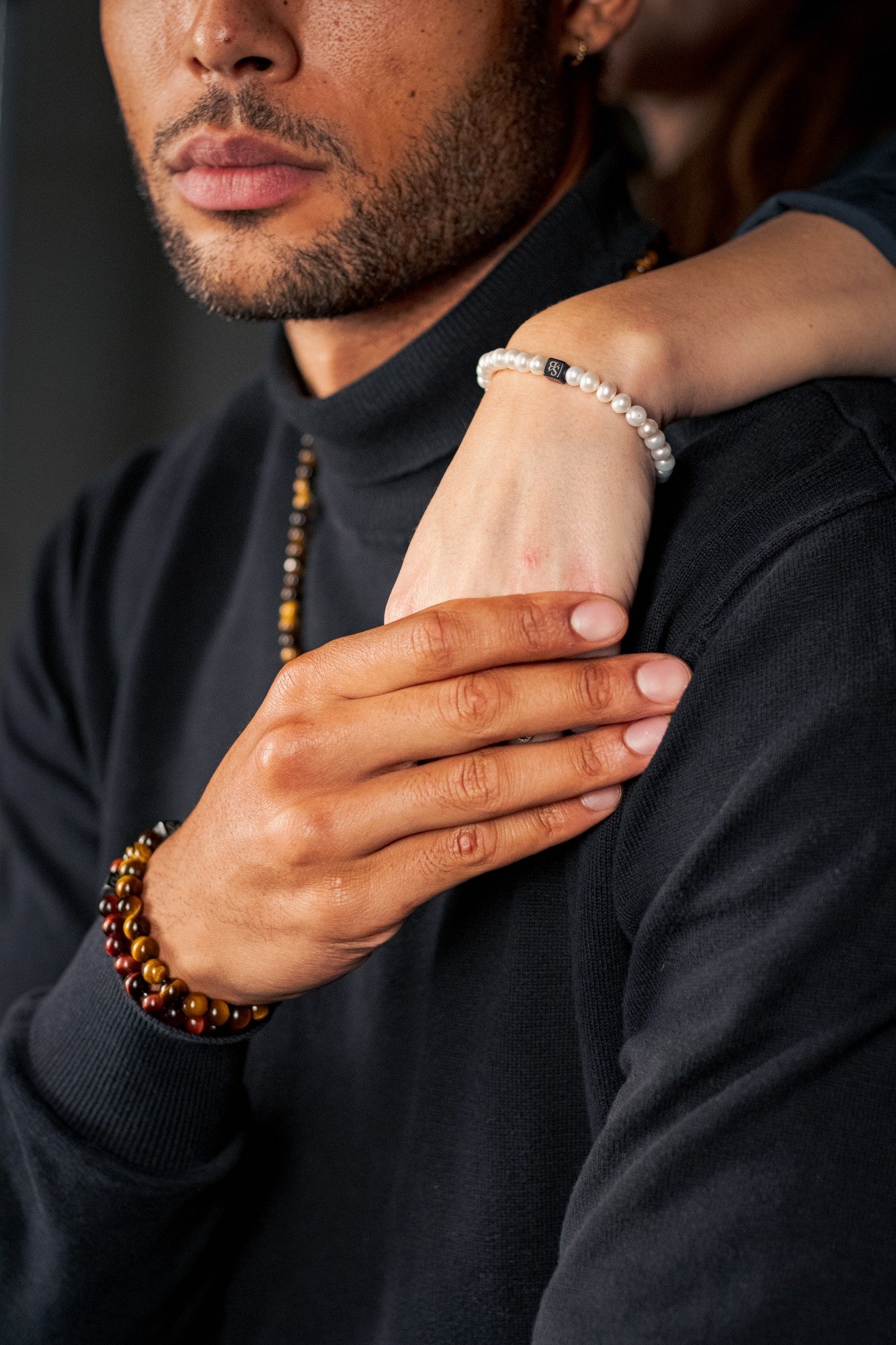
When choosing a piece of jewelry, you eventually encounter the same question: silver or gold? The answer not only determines how the jewelry looks, but also how it interacts with your skin, your watch, and the rest of your wardrobe. In this comparison, we will examine both metals side-by-side regarding color, price, maintenance, and wearability, including how they appear alongside natural stone. We ourselves work with 925 sterling silver accents in our bracelets with silver, so we are particularly familiar with that aspect from practical experience.

Stoney does not sell gold jewelry. Our Superior line combines natural stone with two handmade 925 sterling silver beads, and for those looking for a warm gold tone, we work with gold tiger's eye: a natural stone with a deep golden-brown glow. This comparison is therefore written from a place of material knowledge, not to steer you towards a gold necklace we happen to sell.
The actual difference: color temperature
Strip away all the marketing, and the core difference between silver and gold is a matter of color. Silver is cool, light, and reflects a bluish-white. Gold is warm, deeper, and reflects yellow and orange. This single difference influences everything: which skin undertone it flatters, which clothing it complements, and which stones are best showcased alongside it.
Silver has a cool, bluish-white luster that looks sharp and modern. Gold radiates warm yellow and appears more classic and rich. Neither is objectively more beautiful; they tell different stories.
A cool undertone (veins appear blue) is enhanced by silver. A warm undertone (veins appear greenish) is better complemented by gold. Neutral undertones can wear both.
Gold is many times more expensive per gram than silver. That's why 925 sterling silver is the standard for genuine jewelry at a fair price, while much affordable "gold" is actually a thin layer of plating.
Real silver oxidizes: it slowly darkens and occasionally requires a polishing cloth. Solid gold hardly discolors. Both plated and silver-plated items wear through to the base metal.
Silver vs gold in an honest buying guide
The table below summarizes the most important aspects. Pay particular attention to the last row: for jewelry below a certain price point, the question isn't silver or gold, but real or coated.
| Aspect | Silver (925 sterling) | Gold (solid) |
|---|---|---|
| Appearance | Cool, sleek, modern | Warm, classic, statement |
| Suits undertone | Cool and neutral | Warm and neutral |
| Price level | Accessible for real precious metal | High, especially for 14k and 18k |
| Maintenance | Oxidizes, needs polishing cloth | Virtually maintenance-free |
| Next to natural stone | Highlights dark and cool stones | Enhances warm stones like tiger's eye |
| Pitfall at low price | Silver-plated instead of 925 | Gold-plated or gold-colored alloy |
Are you unsure if a silver-colored piece of jewelry is genuine 925 sterling? Our guide how to recognize real silver offers six reliable checks, from hallmarks to the magnet test.

How to translate metal choice to natural stone
At Stoney, everything revolves around natural stone, and the silver-or-gold logic applies just the same. Every stone has a color temperature, and matching your bracelet to your watch or other jewelry creates a more harmonious overall look. These are the three directions customers choose most often.
Hematite is the most metallic natural stone there is: silver-grey with a mirroring sheen. Combined with the 925 sterling silver beads from the Superior line, you get a completely cool, monochrome wrist that seamlessly complements a steel watch.
View bracelets with silverGold tiger's eye provides the warm, golden-brown glow that gold lovers seek, but as a natural stone with a lively chatoyance that moves with the light. This is the most popular choice for those who want to wear warm tones without buying gold jewelry.
View tiger's eye braceletsBlack is temperature-neutral: an obsidian bracelet never clashes with silver and never with gold. That's why deep black is the safest base for those who own jewelry in both metals or alternate their watches.
View gemstone braceletsFor all these combinations, the same principle applies to fit: 6mm wears subtly and refined, 8mm more assertively. Our size guide explains which bead size suits your wrist.
Can you combine silver and gold?
Old style advice was strict: never mix metals. That advice is outdated. Mixed metals is now a legitimate style choice, provided you do it intentionally. Four rules keep the overall look harmonious.
- Choose a primary metal that accounts for about two-thirds of your jewelry, and use the second metal as an accent.
- Repeat the accent metal at least once, so it appears as a choice and not a coincidence.
- Use a neutral bridge: black or dark gray natural stone connects cool and warm metals without clashing.
- Stick to a maximum of two metal tones per wrist; three becomes too busy.
In the studio, we sort stones by color temperature, just like metals. A warm stone next to a cool bead is immediately noticeable, which is why we physically place every combination side-by-side first.
Stoney AtelierChoose based on undertone and use, not on status. Silver is the most versatile starting point: cool, affordable as a true precious metal, and easy to combine with almost any natural stone. Choose gold if your skin is warm and your budget allows, or achieve the warm glow with gold tiger's eye without the gold price. And for both, prefer real material over a coating.
The cool side, handmade
Natural stone combined with handmade 925 sterling silver beads, hand-assembled in our studio.
View bracelets with silver 20,000+ customers · 1,800+ reviews · 4.8 average
How to recognize real silver? 6 tests, from hallmark to magnet
Mother Daughter Bracelet: A Set You'll Both Truly Wear