

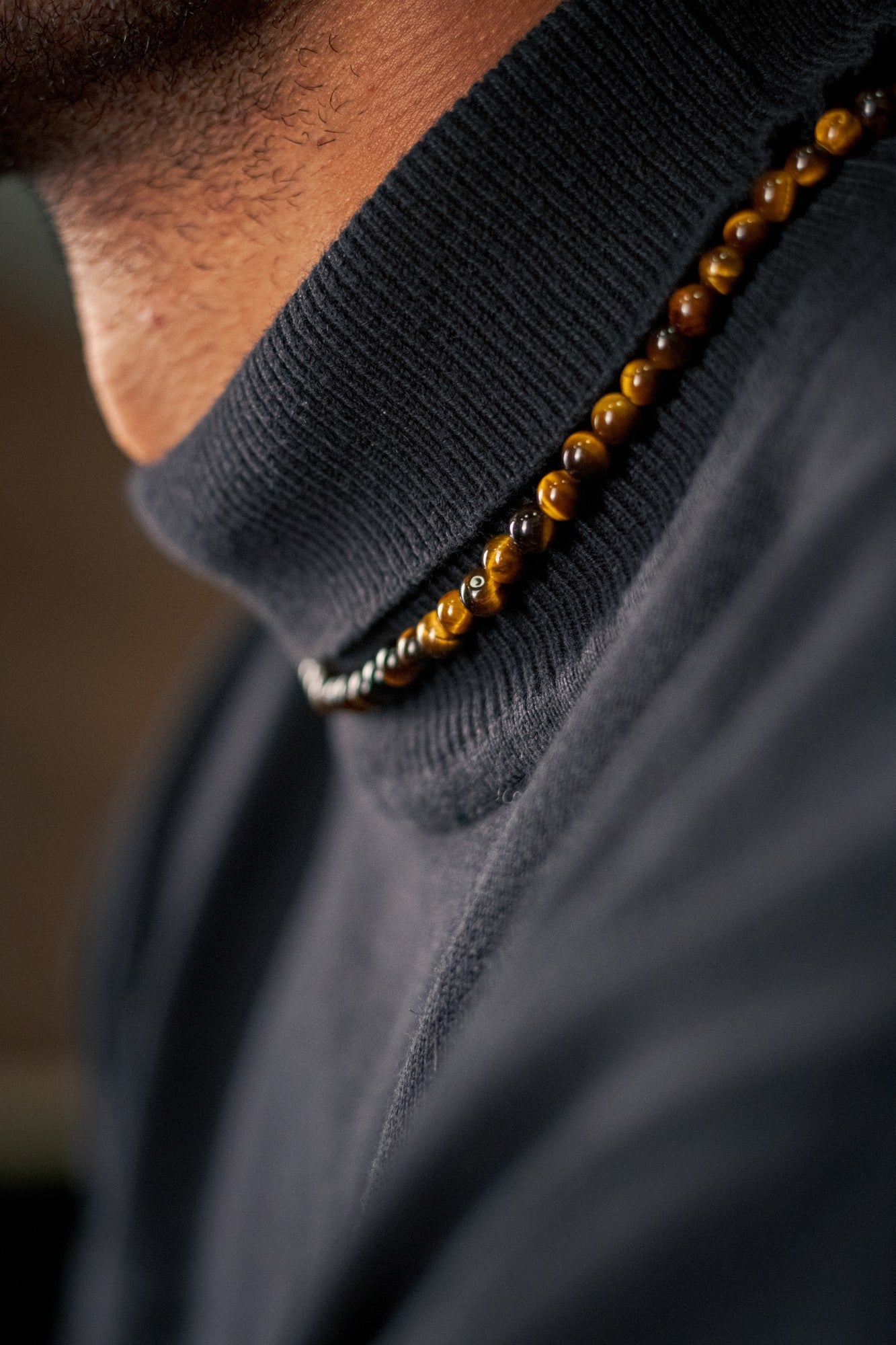
Tiger's Eye is no ordinary gemstone. It's a quartz variant that owes its distinctive golden-brown luster to an optical phenomenon called chatoyancy: a streak of light that moves across the surface when you tilt the stone. This makes every Tiger's Eye bracelet unique. In this article, you'll learn exactly what Tiger's Eye is, how to recognize quality, and why it's one of the most worn stones in the Stoney Bracelets Tiger's Eye collection.

How Tiger's Eye is formed
Tiger's Eye begins its life as crocidolite, a blue asbestos-like mineral. Over millions of years, quartz replaces the crocidolite fibers, fiber by fiber, in a process called pseudomorphosis. The iron in the original fibers oxidizes, giving the stone its warm golden-brown color. The parallel fiber structure remains intact, and that is precisely what causes the cat's eye effect.
The main deposits are in South Africa (Northern Cape), Western Australia, and parts of India. South African Tiger's Eye is generally considered to be of the highest quality due to its broad, well-defined color bands and strong chatoyancy.

Recognizing real Tiger's Eye
With the growing popularity of Tiger's Eye, more and more imitations are appearing on the market. Cheap variants are often dyed glass or synthetic resin with a printed stripe pattern. With these four characteristics, you can immediately recognize the difference.
| Characteristic | Real Tiger's Eye | Imitation |
|---|---|---|
| Play of light | Moving streak of light that shifts when tilted | Static pattern that does not change with movement |
| Temperature | Feels cool to the touch, slowly warms up | Plastic feels immediately at room temperature |
| Weight | Noticeably heavier than glass or plastic of the same size | Lighter, uniform weight |
| Fiber structure | Irregular, natural fiber patterns with subtle variation | Perfect, repeating stripes without variation |
At Stoney Bracelets, we select each bead individually. Stones with weak chatoyancy, cracks, or uneven color distribution are not used. This is reflected in the end result: each bead shows a sharp, moving streak of light. Read our comprehensive guide on choosing a Tiger's Eye bracelet.
Hardness, durability, and daily use
With a Mohs hardness of 7, Tiger's Eye is in the same category as amethyst and citrine. For comparison: steel scores 6.5 and diamond 10. This means that Tiger's Eye is not easily scratched by daily contact with keys, doorknobs, or a desk. It is one of the most practical gemstones for a bracelet you wear every day.
| Stone | Mohs Hardness | Daily Wear |
|---|---|---|
| Tiger's Eye | 7 | Excellent, scratch-resistant |
| Obsidian | 5 - 5.5 | Good, but more susceptible to scratches |
| Lava Stone | 3 - 4 | Porous, requires extra care |
| Lapis Lazuli | 5 - 6 | Good, avoid bumps |
| Hematite | 5.5 - 6.5 | Good, metallic luster |
Care Tips
Clean Tiger's Eye with a damp, soft cloth. Avoid ultrasonic cleaners and chemical agents. Store your bracelet separately from metal jewelry to prevent scratching. After sports or sweating: wipe with lukewarm water and let air dry. More maintenance tips can be found in our care guide for stone bracelets.

Combining Tiger's Eye with other stones
Tiger's Eye is a warm stone with golden-brown undertones. This makes it a strong base for combining with both dark and neutral stones. The rule of thumb: combine warm with neutral for balance, or warm with warm for a statement. These are the three combinations our customers order most frequently.
Curious about the deeper background of this stone? Then also read our article about the meaning of tiger eye and discover why this stone has been worn for centuries as a symbol of strength and focus.
Tiger eye is the stone you don't notice until you wear it. Then everything comes together.
Stoney BraceletsWear a stone that suits you
Hand-selected tiger eye in 6mm and 8mm. Each bead checked for chatoyance and color intensity.
View the collection 20,000+ customers · 1,800+ reviews · 4.8 average
Lava Stone Bracelet for Women: From Raw Volcanic Stone to Feminine Jewelry
Men's Lava Stone Bracelet: Which one suits your style?