

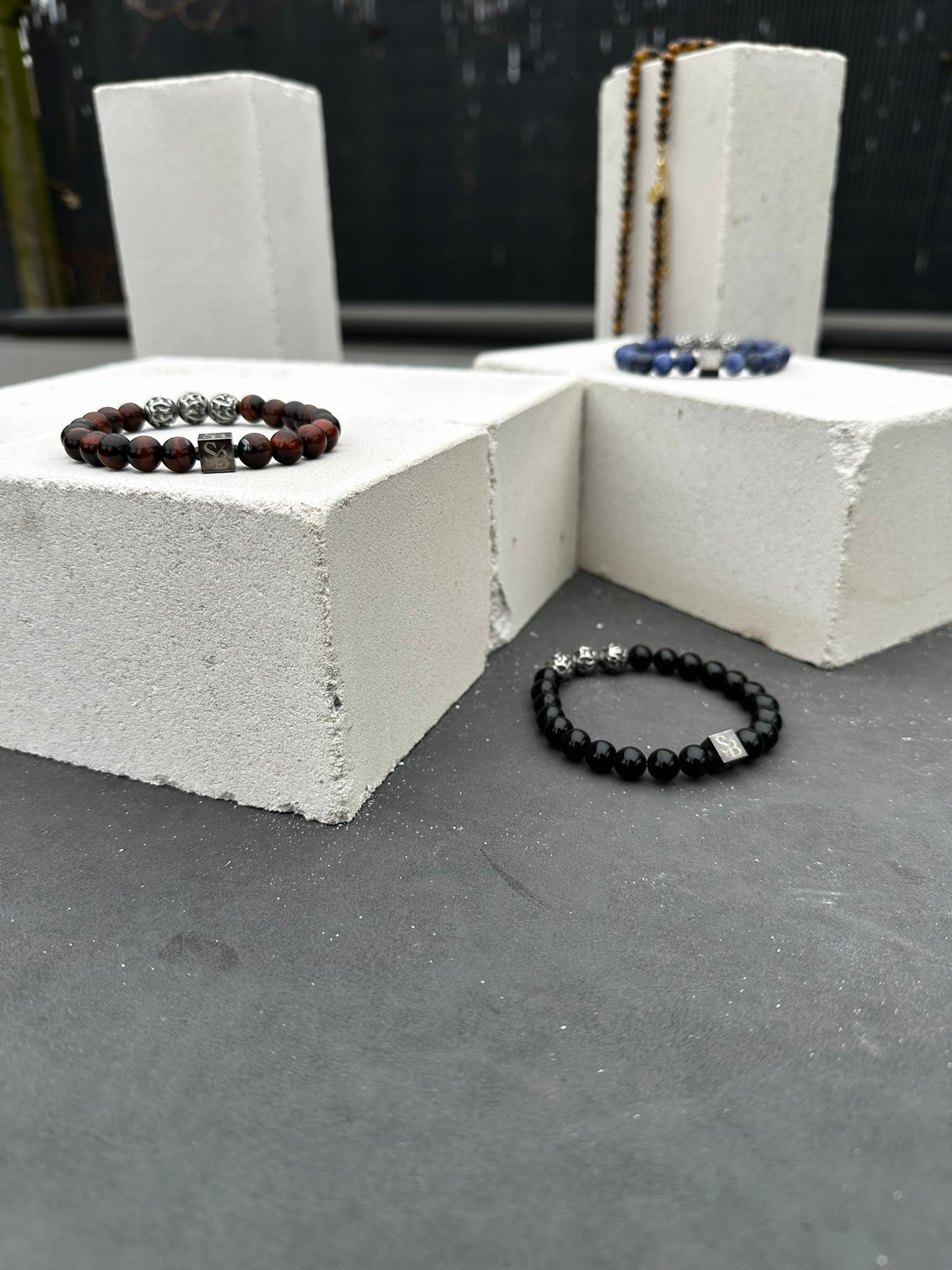
Red is not a color you wear by accident. It’s a choice, and in natural stone, there isn’t just one red stone but an entire spectrum: from warm orange-red carnelian to deep earthy red jasper. Which one you choose determines whether your bracelet stands out or subtly adds warmth. In our collection of red gemstones, you’ll find the entire spectrum together, and in this guide, we’ll explain how to choose the right shade.

What makes a natural stone red
Most red natural stones owe their color to iron. When iron oxidizes in a mineral, shades emerge that range from bright orange-red to deep brick red, depending on how much iron is present and how it is distributed. Carnelian and red jasper are the clearest examples: both are forms of quartz that acquired their warm color through iron oxide. It’s precisely the same chemistry that also colors iron ore and even the red soil of certain landscapes.
Not every red stone works this way. Rhodonite derives its pink-red color from manganese rather than iron, which explains why its hue is softer and cooler than that of carnelian. This different origin is not a detail; it determines the stone's character: an iron-red stone appears warm and grounded, a manganese-red stone appears soft and refined. Those who understand the spectrum choose not by name but by feel.
The red natural stones at a glance
Below, the red spectrum is arranged from the warmest orange-red to the coolest pink-red. The 'character' column helps you choose by feel, and the 'for whom' column indicates for which type of wearer each stone works best. Use this table as a selection aid if you are unsure which red hue suits you.
| Stone | Color nuance | Character | For whom |
|---|---|---|---|
| Carnelian | Orange-red, translucent | Warm, energetic | Those who dare to wear color and shine |
| Red tiger eye | Red-brown with shimmer | Deep, refined | Those who want subtle movement in the stone |
| Red jasper | Brick red, matte | Grounded, robust | Those looking for a warm, masculine matte stone |
| Red agate | Red with veins | Uniquely patterned | Those who want every bead to be different |
| Rhodonite | Pink-red with black | Soft contrast | Those who want to combine warmth with tranquility |

The three strongest red combinations
A red stone is almost always an accent, not a full stack. The color is strong enough to draw the eye on its own, so combine it with neutral base stones that allow the warmth to breathe. These are the three combinations that most often work in our studio.
Red jasper with obsidian
The classic masculine combination. Brick-red jasper against deep black obsidian provides an earthy, robust contrast that never becomes too colorful. This is the stack for those who want to wear red but keep it understated. The matte jasper and glassy black enhance each other's texture.
Carnelian with matte obsidian
Where the previous combination is understated, this one dares to be bold. The translucent orange-red glow of carnelian stands out against matte black, without being garish because the matte surface dampens the light. A statement stack for those who don't want to hide their warm color.
Red tiger eye with hematite
The most refined of the three. The reddish-brown shimmer of tiger eye next to the metallic gray of hematite reads as a stack for under a shirt: warm yet mature, with just enough shine to stand out when the light hits it. Hematite is one of our most ordered base stones and suits almost any red hue.

How you wear red also depends on the size. A brighter stone like carnelian reads more subtly and refined in 6mm, while red jasper in 8mm appears more robust. If you're unsure about the proportion, our guide on 6mm or 8mm bracelets will help you choose the right proportion for your wrist and style.
- Wear a red stone as the only color in the stack and keep the rest neutral black, gray, or brown.
- Combine warm red tones with brown leather or a gold-colored watch; cooler rhodonite with silver.
- Stick to one red strand per arm; two red shades next to each other compete for attention.
- If you want subtle red, choose red tiger eye or jasper. If you want it to stand out, choose carnelian.
"You don't wear red to blend into a stack, but to make one speak."
Stoney atelierWhich red stone we sell the most
Of the entire red spectrum, red jasper is our most popular, and that says something about how men wear red. Jasper is matte, earthy, and understated; it’s red without screaming. The stone adds warmth to an otherwise dark stack without fully demanding attention, and that’s exactly what most wearers are looking for: a hint of color, not a statement. Carnelian follows in second place, chosen by those who specifically want that warm glow.
What we see in the studio is that red is almost never ordered alone. It almost always comes as an accent bead within a combination with obsidian, hematite, or tiger eye. That's why we select our red stones based on color depth and patterning that works alongside neutral base stones, not as a standalone eye-catcher. If you want to delve deeper into the world of red stones, read our guide on the meaning of rhodonite or on the different types of jasper.
Red natural stone is never one uniform color. Two carnelian beads from the same batch can differ in depth and translucency, and red jasper varies from bright brick to almost brownish-red. This is not a flaw but the characteristic of real stone. So, don't expect a uniform color like with dyed material, but a natural spread that makes every bracelet unique.
Choose by feel, not by name. If you want warmth that stands out, go for carnelian. If you want red that remains understated, choose red jasper or tiger eye. If you want a softer, cooler red, choose rhodonite. Wear the stone as the only color against a neutral base, and you'll have a bracelet that adds warmth without ever being garish.
Find your red shade
From warm carnelian to deep red jasper. Hand-selected and strung in our studio, ready to wear as an accent in your stack.
Shop Red Gemstones 20,000+ customers · 1,800+ reviews · 4.8 average
Mohs Hardness Gemstones: Which Scratch and Which Last
Bracelet for the Creative Man: Which Stone Suits a Maker