

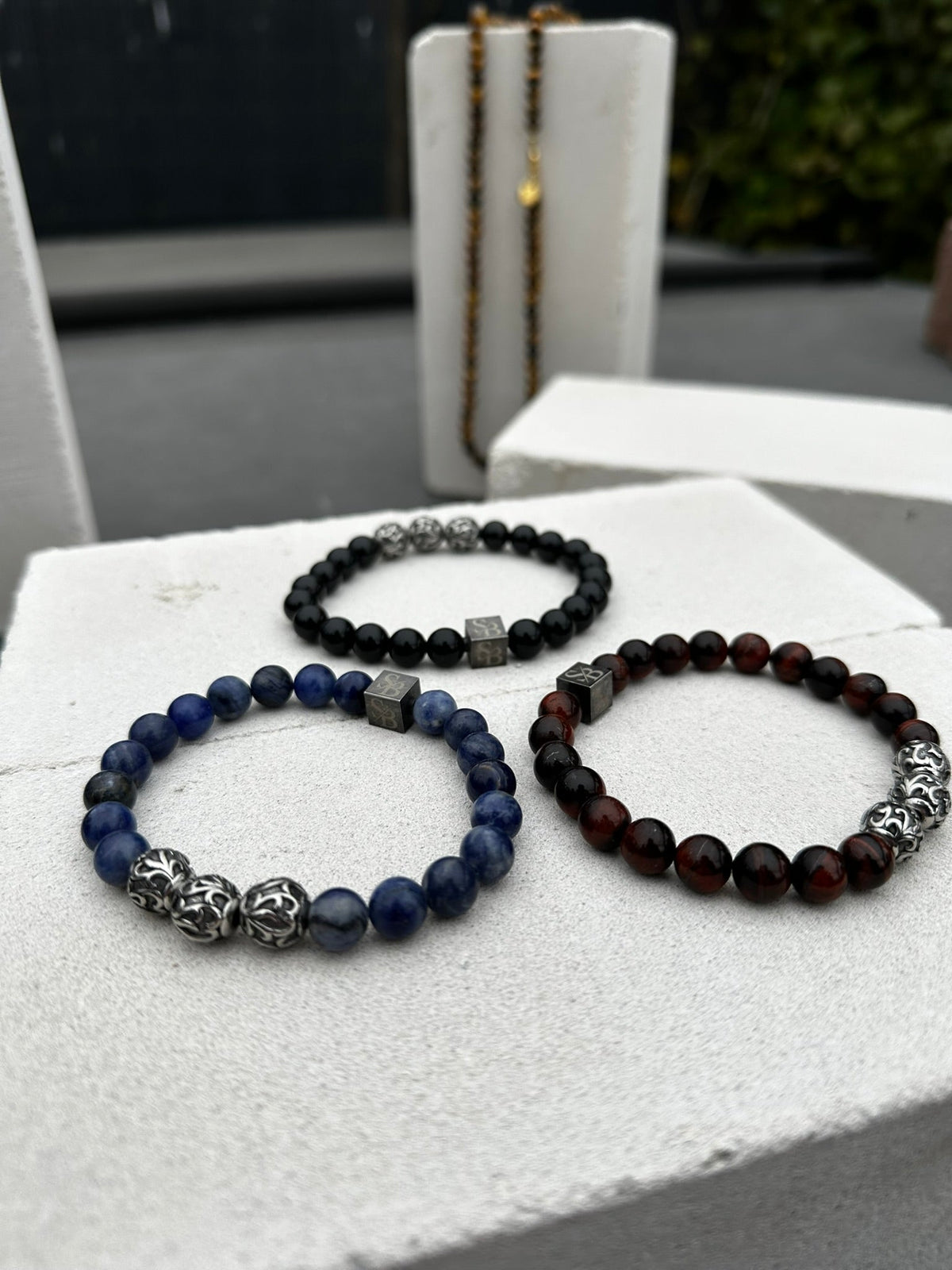
You have three, four bracelets and no idea which combination works. Too many and it looks messy, too few and the stack says nothing. Combining isn't just a matter of taste; it follows a few simple rules regarding number, color, and texture. In this article, we'll list them, along with the combinations our customers wear most often in practice. In the meantime, feel free to check out our ready-made bracelet sets if you prefer not to puzzle it out yourself.

The four basic rules of a good stack
Before choosing stones, it helps to keep four principles in mind. They apply to almost any combination, regardless of which stones you like.
Which stack suits which moment
A stack for a meeting is not the same as a stack for the weekend. Four situations where we most often see customers combining, with the stack that best suits each.
Deep black next to warm golden brown. Works with almost any outfit and is the combination we see most frequently in orders.
Obsidian braceletsMetallic silver-grey next to royal blue. Subtle enough for a business environment, with just enough color contrast not to appear boring.
Lapis lazuli braceletsDeep purple next to black glass. A combination with a bit more color, suitable for a night out without coming across as too busy.
Amethyst braceletsFor intensive use or sports, less is often more. One matte bracelet, or at most two, is the least intrusive and looks deliberately calm.
Men's bracelets
Color and material: what we most often see combined
Some stones naturally combine more easily than others. This table shows which color families we at Stoney most often see ordered together, and what you should rather avoid.
| Color family | Stones | Combines well with | Avoid |
|---|---|---|---|
| Cool dark | Obsidian, hematite, larvikite | Among themselves, or one warm stone as an accent | More than one bright color in between |
| Warm brown-gold | Gold tiger eye, bronzite | Black or grey as a base | Next to an equally bright second warm stone |
| Cool blue | Lapis lazuli, blue tiger eye | Hematite or obsidian | Next to purple or green in the same stack |
| Soft light | Moonstone, labradorite | One dark stone as contrast | Two light stones without a dark anchor point |
| Deep colored | Amethyst, black rhodonite | Neutral base such as obsidian | Combining with another bright colored stone |
How many bracelets is too many
The most frequently asked question we get isn't about which stones, but about how many. Five rules of thumb that we use ourselves in the studio.
- Two to four bracelets is the zone where a stack looks intentional instead of messy
- Maintain one dominant stone, the rest are supportive
- Vary thickness: not three of the same size next to each other
- Mix matte and shiny for visual depth without adding extra color
- Leave space between the stack and a watch, at least two fingers
If you wear a watch, consider the color of the case and strap. That deserves its own explanation, which we cover in detail in combining watch and bracelet. For the size choice itself, 6mm looks more subtle in a stack and 8mm gives more weight: read the full consideration in our guide on 6mm or 8mm.

A good stack is not a collection of loose bracelets; it is one choice consisting of multiple stones.
Stoney StudioStay between two and four bracelets, choose one dominant stone, mix textures, and keep color families together. Obsidian with gold tiger eye is our most ordered combination for everyday wear, while hematite with lapis lazuli works best for the office.
Create your own stack
Or choose from our ready-made sets, curated by color and texture.
View sets 20,000+ customers · 1,800+ reviews · 4.8 average
Natural Stone Bracelet as an Investment: Where Your Money Really Goes
Christmas Gift for Him: A Bracelet He'll Still Wear in March